
Why the Moon?
The Moon repeats itself without ever quite repeating the experience. A clock, a compass, a story—and a golden interruption to an ordinary drive home.
We have probably all been surprised by a beautiful sunset a few times in our lives. You look up from whatever smaller drama has occupied the day and there it is: the sky behaving extravagantly, throwing pink and gold across the whole western edge of things.
Sunrises are a different beast, at least for those of us who are not habitual early risers. A sunrise asks for intent. An alarm. Shoes found in the dark. Coffee negotiated before language. You have to go and meet it.
A moonrise is something else entirely.
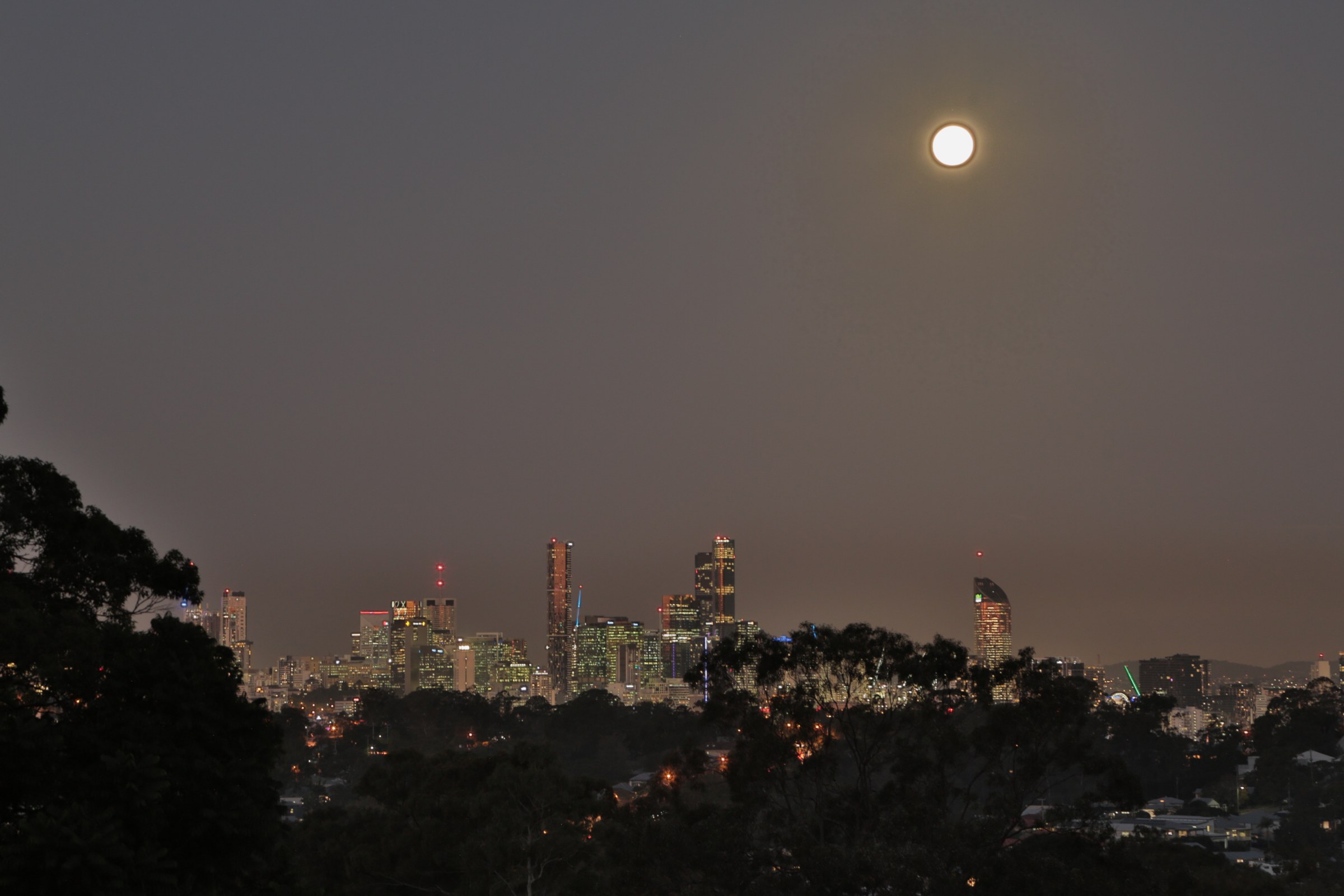
It does not perform at the end of every working day, conveniently opposite dinner. It ambushes you. A preternatural golden orb, impossibly large, peering over the horizon at the most unexpected time. There it is between powerlines. There it is behind a service station sign. There it is coming up beside you as you crawl through traffic or walk an unremarkable suburban street carrying milk home.
For a few seconds, the familiar world acquires another scale.
That is the beginning of my answer to the question why the Moon? It arrives without asking the setting to deserve it.
The grand entrance
The Moon is at its most theatrical when it is closest to the ground—or seems to be. Near the horizon, it can look vast enough to roll down the street. Lift a thumb toward it, though, or photograph it at fixed magnification, and the trick becomes apparent: the Moon has not suddenly swollen. Its angular size is essentially unchanged. The horizon Moon is an illusion, manufactured somewhere between the eye, the landscape and the brain.
Science can describe the effect more confidently than it can settle its cause. Buildings, trees and distant ridgelines give us comparison points; the flattened dome of the sky may alter our judgement of distance; our visual system makes its own quiet corrections. Whatever the mechanism, the result feels less like an error than a gift. The Moon borrows the city for scale, and the city—briefly—borrows the Moon for grandeur.
Its colour is less mysterious. When the Moon is low, its light travels through more of Earth’s atmosphere. Shorter blue wavelengths scatter away, leaving warmer yellows, oranges and reds to reach us. The gold is real light, rearranged by distance.
This combination—the perceptual enlargement and the atmospheric colour—is why moonrise feels like an entrance. A high Moon illuminates. A rising Moon appears.
A sunset performs. A moonrise ambushes.
The same Moon, differently held
One of the things I love most about the lunar phases is that they are shared.
At any given moment, people across Earth are looking at the same phase. A waxing crescent does not become a full Moon when it crosses a border. The Sun, Earth and Moon have one geometry, and that geometry belongs to everyone.
But the view is not identical. Travel between hemispheres and the Moon seems to rotate. The crescent that opens one way in Brisbane appears to open the other way in London. Familiar maria—the dark basalt plains that early observers mistook for seas—change their posture. What looked like a face can become a rabbit, a person carrying sticks, a frog, or simply a map of grey that refuses to settle into any one picture.
People often say the phases are “reversed” between the hemispheres. That is close enough for conversation, but the more beautiful truth is that we are reversed. Observers in the north and south stand at different orientations on a spherical Earth. Look toward the same Moon from opposite sides of that curve and “up” changes. The Moon has not flipped. We have.
There is something quietly useful in that idea. A shared object does not guarantee a shared view. Perspective can alter orientation without altering the thing itself.
The Moon also rocks and rolls slightly over time, an effect called libration. Across a month it lets us peek around the edges, so that, in total, we can see about 59 per cent of the lunar surface from Earth, though never all at once. Even the side we call familiar does not hold perfectly still.
Same Moon. Same phase. Different way up. A little more revealed, then a little less.
One Moon. Eight familiar faces.
A month in moonlight
Follow the cycle. Icons show the Southern Hemisphere orientation; the tilt changes with your position and the time of night.
New Moon
The sunlit side faces away from us. A new cycle begins in near-invisibility.
Waxing crescent
A fine sliver returns to the evening sky. The illuminated portion is growing.
First quarter
Half of the visible disc is lit. The Moon is a quarter of the way through its phase cycle.
Waxing gibbous
More than half is illuminated, still growing toward fullness.
Full Moon
The visible face is fully illuminated. Around full Moon, moonrise falls near sunset.
Waning gibbous
The illuminated portion begins to shrink. The Moon rises later into the evening.
Last quarter
Half of the visible disc is lit again, now on the opposite side.
Waning crescent
A slender crescent appears before dawn, approaching the next new Moon.
New Moon · 1 of 8
A clock without numbers
Before it was a destination, the Moon was a measure.
Its cycle from one new Moon to the next takes about 29 and a half days. That rhythm is slow enough to notice and short enough to use. It divides darkness into a sequence the unaided eye can read: absence, sliver, half-light, fullness, retreat. No mechanism is required. No dial. No literacy. Only attention.
But the Moon has never meant just one thing, and it would flatten thousands of distinct traditions to pretend otherwise. The more interesting pattern is how often people have found practical knowledge and imaginative meaning in the same changing light.
In Aboriginal and Torres Strait Islander cultures, celestial knowledge belongs to particular peoples, Countries and languages; there is no single, interchangeable “Indigenous Moon story.” Within specific traditions, the sky can hold law, seasonal knowledge, navigation, ceremony and relationships between land and living things. Wiradjuri seasonal knowledge, for example, connects lunar phases with environmental cycles. Stories and practices from other communities carry their own meanings and must be understood on their own terms.
Across the Tasman, maramataka—Māori lunar calendars—organise knowledge about the phases and their relationships with planting, fishing, hunting and other activity. They are not relics sealed in the past. They remain living systems of observation, place and practice.
In Chinese traditions, the full Moon of the Mid-Autumn Festival gathers ideas of reunion, distance and return. Families separated by geography can look toward the same bright object. The Moon becomes a form of company: remote, common, undivided.
Korea’s Chuseok also meets the harvest Moon with family, food and remembrance of ancestors. In the Islamic calendar, months begin with the sighting of the new crescent, making the Moon not merely symbolic but consequential: a visible threshold in religious and communal time.
Then there are the figures people find on its surface. Chang’e and the jade rabbit. The Japanese moon rabbit pounding rice cakes. European stories of the man in the Moon. Shapes carried by contrast, culture and expectation. The lunar surface is physically ancient, but the act of looking at it is always contemporary. We bring our moment with us.
This may be the Moon’s strangest double life. It is an exact astronomical object—measurable, mapped, visited—and an inexhaustible field for projection. Rock and story occupy the same disc.
A night in May
On 26 May 2021, I took a camera to Mt Coot-tha and pointed it east across Brisbane.
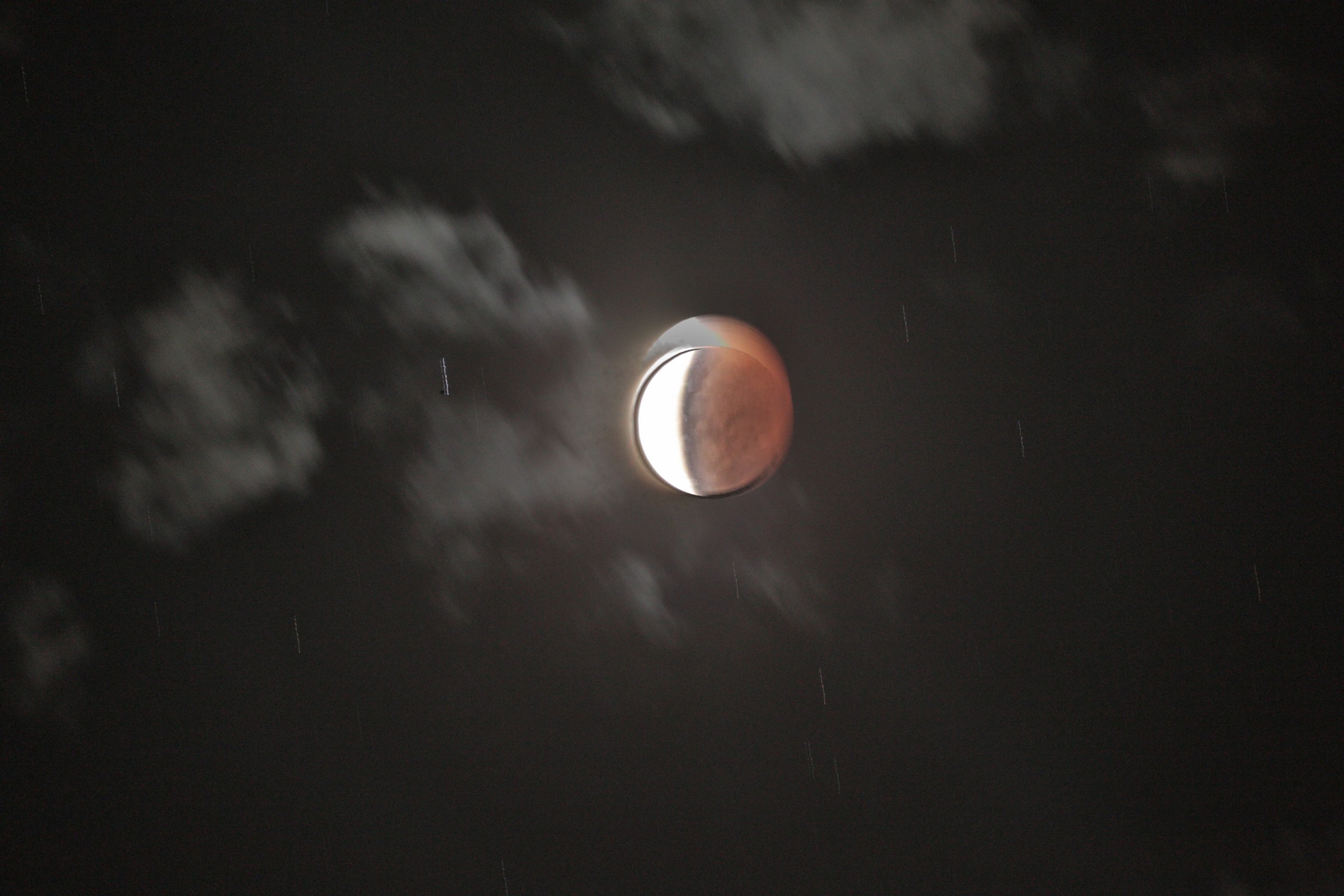
The full Moon rose into a sky still carrying the last violet-blue of evening. It was near perigee, the closer part of its orbit, and that night it would pass through Earth’s shadow in a total lunar eclipse. “Super blood Moon” was the headline-ready version. Through the viewfinder, it was slower and stranger than the name.
First came the clean, pale disc above the city. Then the shadow advanced. Cloud crossed the frame. The Moon darkened into rust and ember, disappeared, returned, and seemed for a while less like a light in the sky than an object suspended inside the weather.
An eclipse clarifies what is usually hidden. Moonlight is borrowed sunlight. The red of a lunar eclipse is sunlight filtered through the rim of Earth’s atmosphere and bent into our planet’s shadow. Every sunrise and sunset happening around the circumference of Earth contributes, in a sense, to that copper glow.
It is a magnificent piece of geometry. It is also difficult to experience as geometry alone.
Standing there with a camera, I was conscious of exposure times, focus, cloud cover and the city lights accumulating below. The practical work of making an image can become a shield against awe: adjust, check, reframe, repeat. Yet the event kept exceeding the apparatus. Between frames I would look up and remember that the shadow crossing the Moon was ours.
Not a cloud. Not a stain. Earth, briefly visible by what it withheld.
Repetition without repetition
The lunar cycle is dependable, but no two encounters feel the same.
The phase repeats. The weather does not. The landscape changes. You change. A crescent seen through winter branches is not the crescent glimpsed above a hotel roof in another country, although the illuminated fraction may be nearly identical. The Moon gives us repetition without monotony: structure with room for circumstance.
This is probably why I keep returning to it in photographs and film.
A camera is often accused of taking us out of the moment. Sometimes it does. Sometimes it trains us back into one. To photograph the Moon is to learn its timing, to notice the direction of rise, to watch where the light thins and the cloud thickens. The photograph is not the prize so much as the evidence of attention.
There is humility in the attempt, too. The Moon is one of the most photographed objects in human history. No image I make will reveal that it exists. Originality has to come from the relationship: this Moon, over this city, from this hill, through this weather, witnessed by this person on this night.
That limitation is freeing. It shifts the task from conquest to encounter.
The photograph is not the prize so much as the evidence of attention.
So, why the Moon?
Because it is close enough to recognise and distant enough to resist us.
Because it is a clock with no numbers and a mirror that shows not our faces but our position.
Because people separated by oceans can stand beneath the same phase while seeing it from a different angle. Because communities have made calendars, ceremonies, stories, warnings, gods, rabbits and family reunions from its light. Because its surface is fixed enough to map and ambiguous enough to imagine.
Because it makes the everyday porous.
You can spend all day inside schedules, screens and rooms built to human scale. Then, on the way home, something immense appears behind the roofs. It has been travelling toward that horizon with perfect indifference to your inbox. It asks nothing of you except the small act of noticing.
The traffic moves. The light changes. Someone behind you is impatient.
Still, for a moment, the Moon is right there—golden, oversized, peering over the ordinary world as if it has caught you by surprise.
And perhaps that is the answer. I am interested in the Moon because it keeps reminding me that looking up is not an escape from where we are. It is one way of understanding it.